ASSESSMENTS

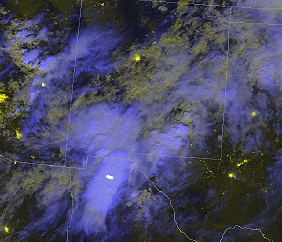
VIIRS Front Range Nighttime Imagery

Description:


This report describes the 2013/14 assessment of multi-spectral imagery produced by the NASA Short-term Prediction Research and Transition (SPoRT) Program from the MODIS and VIIRS polar-orbiting instruments for application by its Weather Forecast Office (WFO) collaborators within the NWS Southern and Eastern Regions. NWS forecasters provided feedback via online surveys or blog posts after viewing data within their native display system for a relevant event where products were used to support aviation hazards and cloud analysis. GOES 11-3.9µm difference imagery has traditionally been used to analyze and track low clouds and fog at night to support the preparation and amendment of TAFs. The DNB and NTmicro RGB products provide additional information within a single image to increase the forecaster's awareness of cloud characteristics that apply to aviation hazards.

Participants: ABQ, BOU, CYS, TFX
Language:
English
Publication Date: April 2014
Season: 1 July - 31 August 2013
Forecast Challenge: Dust, smoke, and cloud analysis at night
Categories: Multispectral Imagery, Aviation

Provide Feedback

Other Product Assessment Forms

Aviation and Cloud Analysis using RGB Imagery by High Latitude Forecasters

Aviation and Cloud Analysis using RGB Imagery by Southern Region WFOs

VIIRS Front Range Nighttime Imagery

View All

Assessment Reports

  • Total Lightning Assessment (view)

    15 May - 15 August 2014
  • RGB Imagery Evaluation for Aviation and Cloud Analysis (view)

    October 2014
  • UAH CI Assessment Results (ver. 3) (view)

    August 2013
  • Alaska NESDIS GOES-R QPE and CIRA LPW 2013 Assessment (view)

    June 2013
More Reports
Product Assessments
The SPoRT Center produces online surveys for several products in support of SPoRT's research and transition to operations. Surveys provide a quick and easy method for SPoRT to determine the effectiveness of the products transitioned. SPoRT prides itself on not "throwing data over the fence" by continuing to support our National Weather Service partners even after a product has been transitioned, and the surveys provide a means for interaction between SPoRT researchers and operational meteorologists. Each of the surveys below provides links to the survey itself, a summary of all surveys for a particular product, and the online training modules for the product being surveyed. View survey results.